Infusion provides several ways to move data in and out of the system.
They serve different purposes from day-to-day bulk updates of customers and products to one-time migration to Infusion or bank reconciliation and payment files.
This article explains the main import and export types, where to find them, and the general workflow.
Key points to note
- CSV is the primary format for bulk import and export of master data (customers, suppliers, products, financial setup).
- The recommended path for importing when export is available is export → edit → re-import.
- Bulk CSV imports validate every row before saving. If any row fails validation, nothing from that file is imported until you fix the errors and try importing again.
- Excel files are not accepted for bulk master-data import. Save your file as CSV (UTF-8) before uploading.
- Grid CSV export (from list toolbars) is useful for reporting but is not always suitable as a re-import template.
Where to find Import and Export
Use the ...More Options menu to start an import or export. In some instances, importing and exporting is also available via Spill menu, e.g. GL Account transactions.

Data is transferred in .csv files (with the exception of Bank Imports which offer other file formats to import).
Imports and Exports
Customers
Customers list > …More Options > Import or Export
Import |
Export |
| Customers | Customers |
| Customer Adjustments | Customer Adjustments |
| Customer Contacts | Customer Contacts |
| Customer Sales Budgets | Customer Sales Budgets |
| Customer Contract Rates | Customer Contract Rates |
Additional export: BNZ invoice export (New Zealand only, where enabled).
Supplier
Supplier list > …More Options > Import or Export
Import |
Export |
| Suppliers | Suppliers |
| Supplier Adjustments | Supplier Adjustments |
| Supplier Contacts | Supplier Contacts |
Supplier Purchase Order Product lines can be Imported from the Purchase Order detail screen.
Products
Product list > …More Options > Import or Export
Import |
Export |
| Product | Products |
| Product Price Levels (fixed prices) | Active Product Price levels |
| Product Promotional Prices | Active and Pending Promotional Pricing |
| Quantity Break Pricing | Active Quantity Break Pricing |
| Active Product Min/Max and Bin Locations | Active Product Suppliers |
| Product Suppliers | Products with Stock Status |
| Active Product Min/Max and Bin Locations |
Promotional and quantity break options appear only when those features are enabled in product settings.
Financials
Financials > …More Options > Import or Export
Import |
Export |
| Chart of Accounts | Chart of Accounts |
| Profit and Loss | Profit and Loss |
| Balance Sheet | Balance Sheet |
| All GL transaction | |
| Export Financials to MYOB Accountants Office | |
| Export Financial to CCH iFirm |
Rules
Import rules
The import file doesn’t need to have every single column included in the export. Instead, only the columns for the changes and columns to identify the information need to be included. The column names need to exactly match the names of the columns in the export.
Exported files are available from the Windows Downloads folder or the status bar of the browser.It can be useful to run an export prior to importing to check the required columns and existing data.
Copy the column headers to a new document to start a fresh import.
After an import
Any records changed in the .csv file update the record in Infusion.
New records in the .csv file are added to Infusion.
Existing records in Infusion do not change if there is no change or it is not included in the .csv file
Troubleshooting
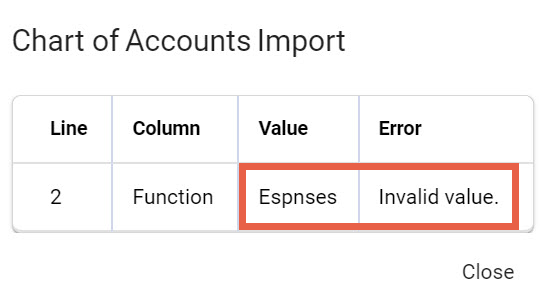
If there are errors when running an import, a window displays with a description and reference to the impacted row and column.
The import will not proceed whilst there are errors within the file and these need to be corrected to run a successful import.